
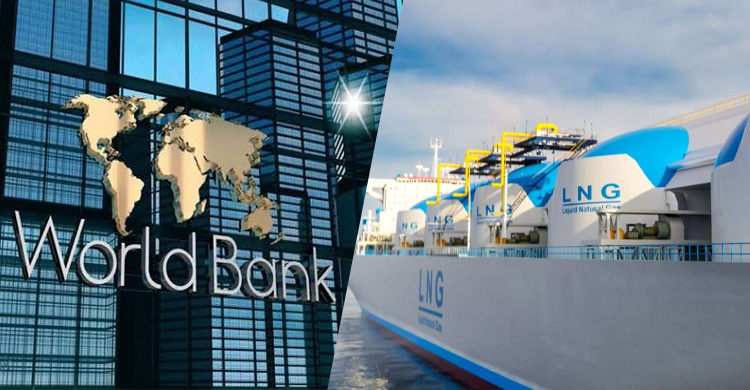
 Bangladesh is set to secure an additional $350 million World Bank loan guarantee for LNG imports by November, raising the total facility to $700 million. The move aims to help state-run Petrobangla ensure timely payments for imported gas amid rising demand and mounting pressure on foreign exchange reserves.
Petrobangla officials confirmed that the amendment and negotiation process for the expanded facility is expected to be completed by August. Following this, the company will seek board approval, Energy Division clearance, and legal vetting by the law ministry before signing revised agreements. The Economic Relations Division is expected to place the proposal before the World Bank board in October, with disbursement likely in November.
AKM Mizanur Rahman, director of finance at Petrobangla, said the existing $350 million structure will be doubled to $700 million, requiring amendments or restatements to four agreements. A high-level negotiation committee comprising representatives from several ministries, Bangladesh Bank, and Petrobangla is currently engaged with the World Bank and a consortium of three Singapore-based banks.
The World Bank’s existing $350 million facility under the Energy Sector Security Enhancement Project was approved on 18 June 2025, became effective in early 2026, and will run until 31 December 2031.
Financing designed for LNG imports
Unlike conventional loans, the $700 million package will be a contingent financing facility designed to guarantee LNG import payments. Of this, $650 million will be available through standby letters of credit (SBLCs), while $50 million will serve as a credit support line. Petrobangla must issue SBLCs by November to access the facility.
The current structure includes $250 million for long-term LNG contracts and $50 million for spot-market purchases. Petrobangla has already used $235 million of the long-term allocation and twice drawn from the spot facility. A key feature of the arrangement is its revolving nature, allowing reuse once payments are settled.
Facility to ease forex pressure
Officials noted that the expanded guarantee will enable Bangladesh to import LNG without immediately straining foreign exchange reserves, thereby strengthening energy security. Domestic gas production continues to decline, increasing reliance on LNG for power generation, industry, and other sectors.
Between 2018 and April 2026, Bangladesh imported 37.014 million tonnes of LNG via 597 cargoes. QatarEnergy and Oman’s OQ Trading remain major long-term suppliers, while spot purchases fill additional demand.
Petrobangla projects that Bangladesh may require 30 million tonnes of LNG annually by 2041, with daily demand reaching 8 billion cubic feet. However, global price volatility and geopolitical risks, particularly in the Middle East, pose challenges. Any disruption to long-term supplies could force higher spot-market purchases, raising costs and pressure on reserves.
