
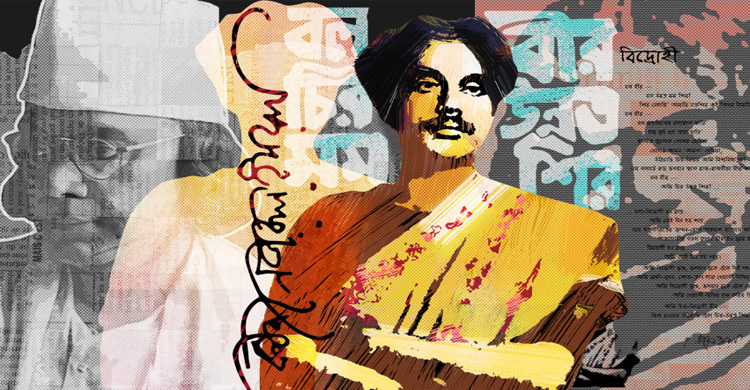
 The cultural arena of the country will observe the 50th death anniversary of National Poet Kazi Nazrul Islam tomorrow. The poet, who was a revolutionary, journalist, lyricist, composer, playwright, and novelist, is one of the most celebrated cultural icons of the nation.
Bangladesh Shilpakala Academy, Chhayanaut, Jatiya Kabi Kazi Nazrul Islam University, Bangla Academy, Nazrul Institute, and many other socio-cultural organisations will arrange special programmes to observe the death anniversary of the national poet tomorrow.
Bangladesh Shilpakala Academy has arranged a two-day programme, marking the day. The event features discussion and cultural programme.
Prominent cultural organisation Chhayanaut will hold a special programme titled “Shotoborsho Utjapon-Nazruler Gaane Matoyara Dhaka” at their auditorium 7:00 pm.
Bangladesh Television and other private television channels will also air various show highlighting the life and works of Nazrul Islam.
Duronto TV will air “Sokal Belar Pakhi” at 8:00am and 12:00pm. In this special show, the little friends of “Kolporekha” gave a dramatic presentation of various poems written by the poet. Musical show “Ganer Pakhi Bulbul” with some famous songs written by Kazi Nazrul, will be broadcast at 8:30am and 5:30pm. Debashmita Kundu, Anandi Ghosh, Ahnaf Nabi Arik, Tanchai Bala Tithi and Tashfia Tasnim Gungun sang in this special show.
Born on 24 May 1899 or 11 Jaishthya 1306 at Churulia village in the Burdwan district of West Bengal in undivided India, Nazrul had to leave his studies at an early age to earn his living as his father died when he was 11.
Initially, he joined a professional leto troupe, where he was introduced to the richness of Bangla and Sanskrit literature. He returned to school a year later and enrolled in Matharun English School, but dropped out of class-VI due to poverty. This time, he worked with a Kabi Gaan troupe and subsequently took up a job at a bakery.
While working there, Nazrul started writing poems, and his talent soon attracted the attention of a police officer named Kazi Rafikullah, who gave him shelter at his house in Mymensingh’s Trishal in 1914 and enrolled him in class-VII at Darirampur School. Nazrul joined the British Army in 1917. During his two and a half years of service, the young poet was introduced to Persian literature and learned to play different instruments following notation. His first poem, Mukti, first novella ‘Bounduler Atmakahini’, novel ‘Badhon Hara’ and a number of other writings were published during that period.
In his short creative life, Nazrul also worked as a lyricist and music composer for popular music brand HMV (His Master’s Voice). He developed 17 new ragas and created six new taals (rhythms).
He also acted in a film and directed music as well. He joined All India Radio Kolkata in October 1939.
But, Nazrul suddenly fell sick in 1942 and was diagnosed with a rare neurological disorder named Pick’s disease that led to the loss of his voice and memory. He was sent abroad for treatment but could not recover.
In his short artistic career of just over 20 years, he penned 3,174 songs, 600 poems, three novels, and 43 essays.
After independence in 1972, Nazrul was declared the national poet, and brought with due honour to Bangladesh. Nazrul was awarded an Honorary D Litt by the University of Dhaka in 1974 and Ekushey Padak in 1976 by the Bangladesh government.
Nazrul died in Dhaka on 29 August 1976 (12 Bhadra 1383) and was buried beside the Dhaka University Central Mosque.
